Unlocking Your Potential: The Power of a Growth Mindset
In every workplace, you’ll find people with similar résumés, similar skill sets, and similar levels of experience. Yet some of them grow faster, adapt more smoothly, and consistently outperform expectations.
Why?
Often, it comes down to one thing: mindset.
While knowledge and talent matter, the way you think about your abilities—your belief about whether you can grow or whether you’re stuck with what you have—shapes everything else. This is the foundation of psychologist Carol Dweck’s work on fixed vs. growth mindsets. And decades later, it remains one of the most powerful lenses for professional success.
Fixed vs. Growth Mindset: The Difference That Drives Performance
A fixed mindset suggests that your intelligence, skills, and strengths are set in stone. You either “have it” or you don’t. People with a fixed mindset tend to avoid challenges, resist feedback, and give up quickly when things get difficult—because struggle feels like a threat to their identity.
A growth mindset, however, assumes that with effort, good strategy, and the right support, you can expand your abilities over time. Setbacks are not indictments; they’re data. Challenges are not proof that you don’t belong; they’re opportunities to build capacity.
At work—where change is constant and expectations evolve quickly—this difference is enormous. A growth mindset not only fuels personal development; it strengthens teams, improves performance, and builds cultures that innovate instead of stagnate.
What a Growth Mindset Looks Like at Work
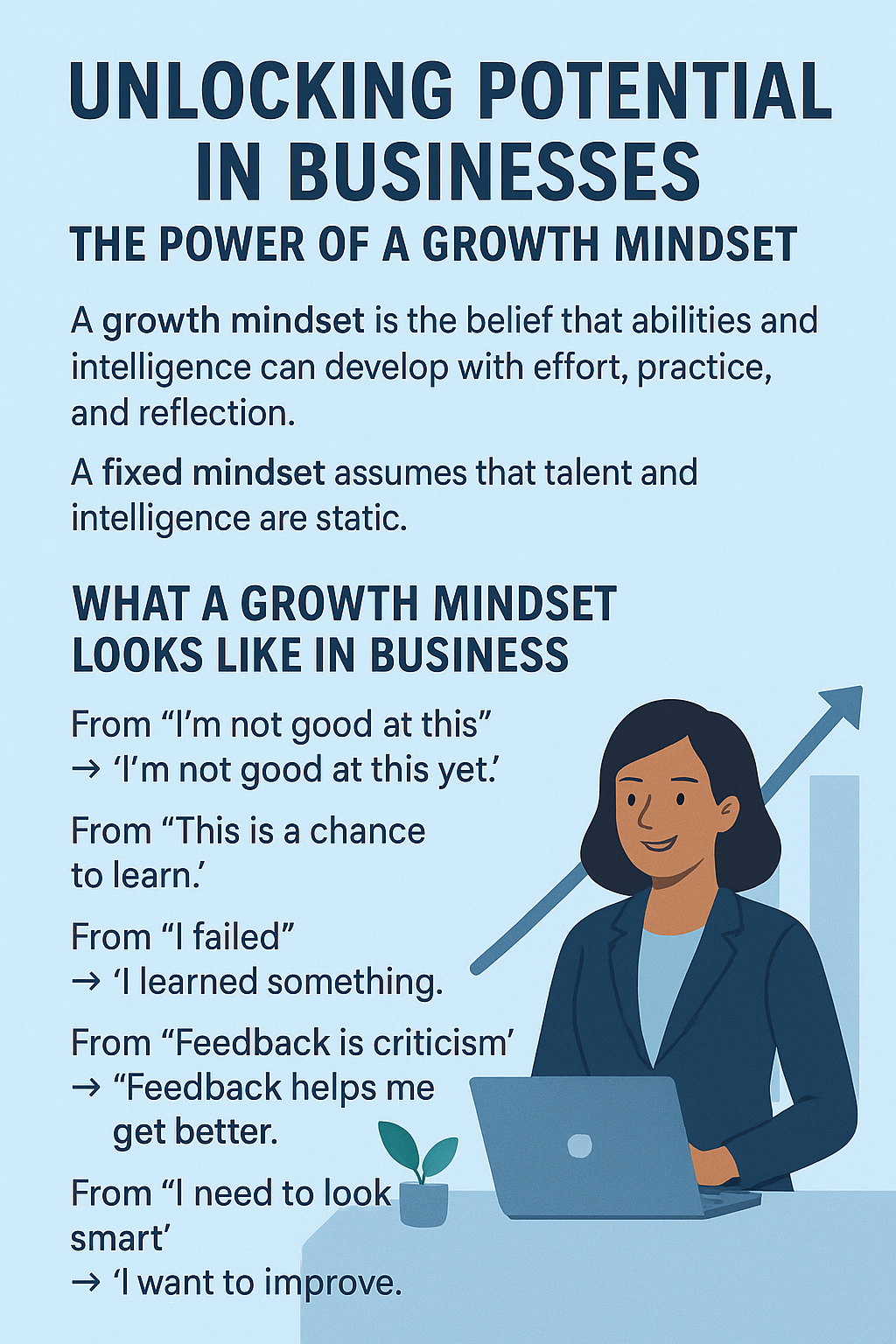
You don’t shift from fixed to growth by simply “deciding” to be more positive. You shift by changing the internal dialogue and behaviors that drive your daily interactions.
Here are practical examples of mindset shifts that make a real difference:
1. From “I’m not good at this” → “I’m not good at this yet.”
That simple word—yet—keeps possibility open. Instead of shutting down, your brain starts looking for ways to improve. This mindset helps employees take on new software, new responsibilities, or new leadership expectations with less fear and more curiosity.
2. From “This is too hard” → “This is where I grow.”
Difficult tasks are not a threat; they’re strength training.
Every challenge becomes a rep that builds resilience, competence, and confidence.
3. From “I failed” → “I learned.”
A fixed mindset stops at the mistake.
A growth mindset asks:
What went well?
What didn’t?
What will I adjust next time?
Organizations that normalize this kind of reflection see fewer repeated mistakes and far greater innovation.
4. From “Feedback is criticism” → “Feedback is fuel.”
Top performers are not the ones who avoid critique—they’re the ones who seek it out. They view feedback as an accelerant for growth, not a threat to their ego.
5. From “I need to look smart” → “I need to get better.”
When the priority is looking competent, people hide weaknesses and avoid risks. When the priority is improving, people ask questions, raise concerns early, and collaborate more openly.
This shift creates teams that communicate more clearly, solve problems faster, and support each other’s development.
Why a Growth Mindset Matters at Every Level of an Organization
When individuals adopt a growth mindset, workplaces change in meaningful ways:
• Increased resilience
People bounce back from setbacks faster because they understand that difficulty is part of the process—not a verdict on their abilities.
• More innovation
Employees feel safer experimenting, sharing ideas, and proposing solutions that push boundaries.
• Stronger collaboration
A growth-minded team is less focused on blame and more focused on collective learning.
• Faster skill development
Learning becomes continuous, not reactive. People take ownership of their professional growth instead of waiting to be told what to improve.
• A healthier culture
Psychological safety rises. Accountability strengthens. And people show up with greater confidence and openness.
How to Strengthen a Growth Mindset in Your Daily Work
If you want to reinforce these habits, start small:
Reframe challenges as opportunities to stretch.
Ask for feedback regularly—and act on it.
Celebrate effort and progress, not just outcomes.
Reflect after projects to capture the learning.
Surround yourself with people who challenge and inspire you.
Mindset shifts are simple, but not always easy. They take intention, practice, and self-awareness. But once you adopt a growth mindset, you’ll find that your capacity expands—often faster than you expected.
The Bottom Line
Your mindset sets the ceiling—or removes it entirely.
If you want better results, start with better beliefs. Your skills, your performance, and your career will follow.