
Real Productivity vs. Looking Busy
A few years ago, I was sitting across from a school leader who looked completely spent.
He told me, almost proudly, “I’m working from 7 a.m. until 10 p.m. most days. I don’t stop moving.”
There was a pause. Then he added something quieter.
“I just don’t feel like I’m actually getting ahead.”
That sentence has stayed with me, because it names a tension so many leaders experience but rarely say out loud. We are constantly doing things, yet we’re not always making progress on the things that matter most.
This is the difference between real productivity and perceived productivity.
And confusing the two is one of the fastest paths to burnout.
The performance of productivity
Perceived productivity is loud.
It shows up as:
Back-to-back meetings all day
An inbox that never quite empties
Notifications buzzing nonstop
A calendar so full there’s no room to think
From the outside, it looks impressive. It signals commitment. It tells the world, “I’m important. I’m needed.”
But from the inside, it often feels frantic and unsatisfying.
I hear this all the time from leaders:
“I’m exhausted, but I’m not sure what I actually accomplished today.”
That’s not a time management problem.
That’s a clarity problem.
What real productivity actually looks like
Real productivity is quieter and, at times, uncomfortable.
It looks like:
Blocking off time to think instead of jumping into another meeting
Making a decision you’ve been avoiding
Saying no to something good to protect something essential
Creating systems so you don’t keep solving the same problems over and over
Ironically, when you’re truly productive, it can look like you’re doing less.
Less visible motion.
Less constant responsiveness.
Less “proof” of busyness.
But far more impact.
A simple but revealing story
I once worked with a leader who made a bold change: he reduced his meetings by nearly 30%.
No grand announcement. No productivity app. He simply asked a better question before accepting meetings:
“Do I actually need to be in this?”
At first, people noticed. Some even assumed things had slowed down.
In reality, the opposite happened.
He was making clearer decisions.
He was more present with his team.
Small issues stopped becoming big fires.
He didn’t work longer hours. He worked with intention.
What changed wasn’t his effort.
It was his focus.
Why “looking busy” feels so tempting
Perceived productivity gives us comfort.
Busyness feels measurable.
Full calendars feel responsible.
Exhaustion feels like evidence that we care.
But caring deeply doesn’t require chaos.
And effort alone is not the goal.
Impact is.
Real productivity requires space — space to think, to prioritize, to choose. That can feel risky in cultures where responsiveness is rewarded and stillness is mistaken for disengagement.
So we keep moving.
Even when movement isn’t progress.
The question that changes everything
The leaders who break out of this cycle stop asking:
“How much can I cram into my day?”
And start asking:
“What actually deserves my best energy today?”
That single shift changes how you schedule your time, how you show up for your team, and how you feel when you shut your laptop at night.
It replaces reaction with intention.
Where this work really happens
This distinction between real and perceived productivity is at the heart of ProductiveU, my upcoming productivity training.
This isn’t about hacks, hustle, or squeezing more into an already full life.
It’s about helping leaders:
Step out of constant reaction mode
Clarify what truly matters
Build rhythms and systems that support sustainable, meaningful work
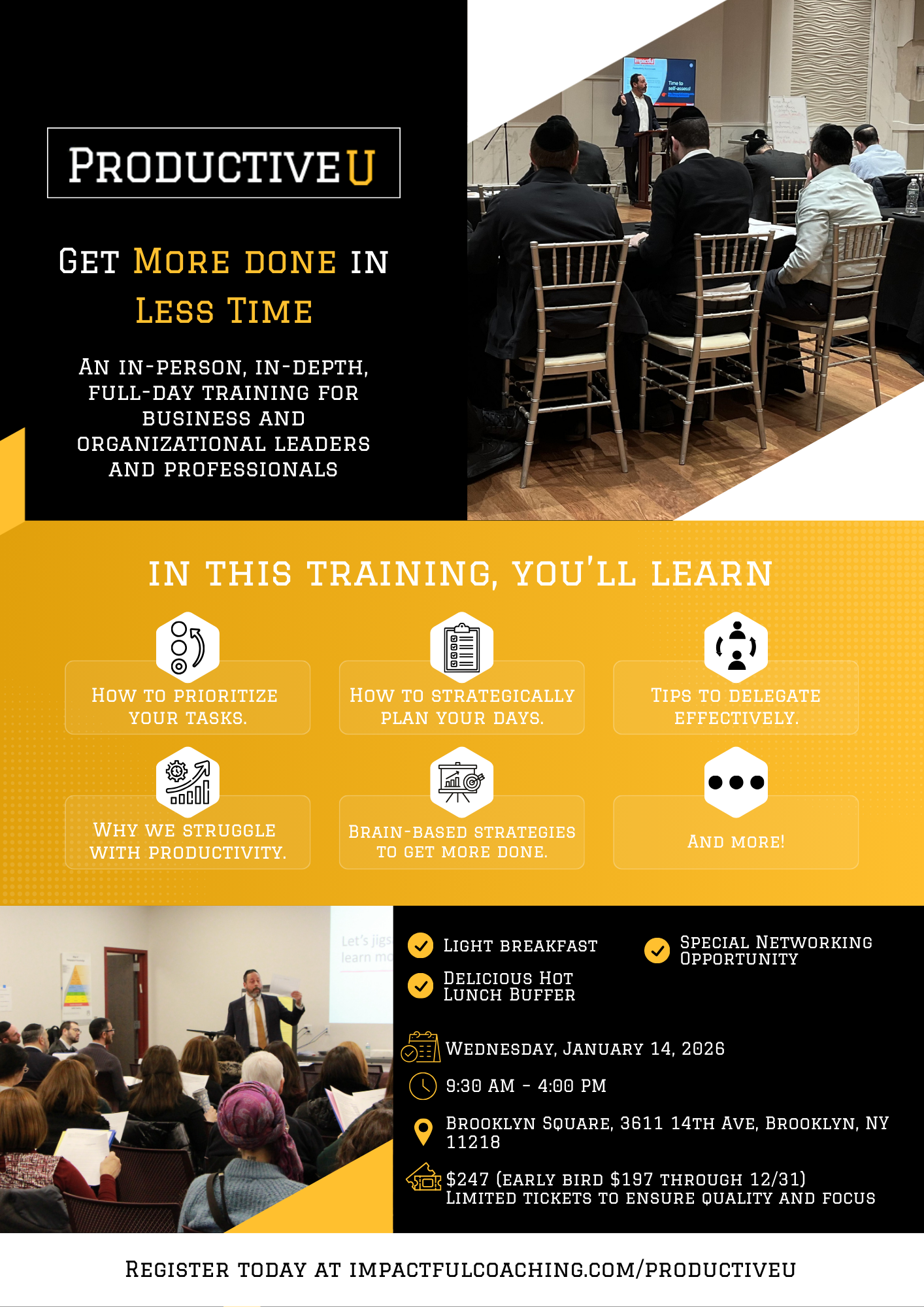
Want to go deeper and be sure that your goals stick? Attend my in-depth full-day productivity training session on January 14!