
Talk Less. Lead Better.
A leader once told me, “I’ve explained this a dozen times. I don’t know why they still don’t get it.”
A week later, I watched him run a team meeting.
He talked for most of it.
He clarified expectations.
He answered his own questions.
He ended with, “Any questions?”
There were none.
Not because everyone understood—but because everyone had learned that questions weren’t really welcome.
That moment captured one of the most common leadership blind spots I see:
we mistake communication for talking, and leadership for giving answers.
But the leaders who build strong, capable, engaged teams do something fundamentally different.
They coach.
The communication gap leaders underestimate
Here’s a stat that stops many leaders in their tracks:
Gallup consistently finds that managers account for at least 70% of the variance in employee engagement.
Read that again.
Not perks.
Not pay.
Not mission statements.
Leadership behavior—especially communication—shapes how people experience their work every single day.
Yet many leaders were promoted because they were good doers, not because they were trained communicators or coaches.
So, they default to what feels efficient:
Explaining instead of asking
Correcting instead of exploring
Solving instead of developing
It feels helpful.
It feels productive.
But over time, it creates dependency, disengagement, and silence.
Communication isn’t about clarity alone
Most leaders pride themselves on being “clear.”
Clear goals.
Clear instructions.
Clear expectations.
Clarity matters—but it’s not sufficient.
Because leadership communication isn’t just about whether your message makes sense.
It’s about what your message invites others to do.
Does it invite:
Ownership or compliance?
Thinking or waiting?
Growth or avoidance?
People don’t disengage because leaders lack information.
They disengage because they stop feeling trusted, heard, or developed.
The shift from telling to coaching
Coaching doesn’t mean being soft.
It doesn’t mean lowering standards.
And it definitely doesn’t mean avoiding accountability.
It means changing the direction of communication.
Instead of:
“Here’s what you should do.”
Coaching sounds like:
“How are you thinking about this?”
“What options have you considered?”
“What support would help you move this forward?”
One leader I worked with realized he answered questions too quickly—often before his team had time to think.
He tried something simple: pausing.
At first, the silence felt uncomfortable.
Then something interesting happened.
People started bringing better ideas.
They took more initiative.
They stopped escalating every small decision.
Nothing changed structurally.
But everything changed relationally.
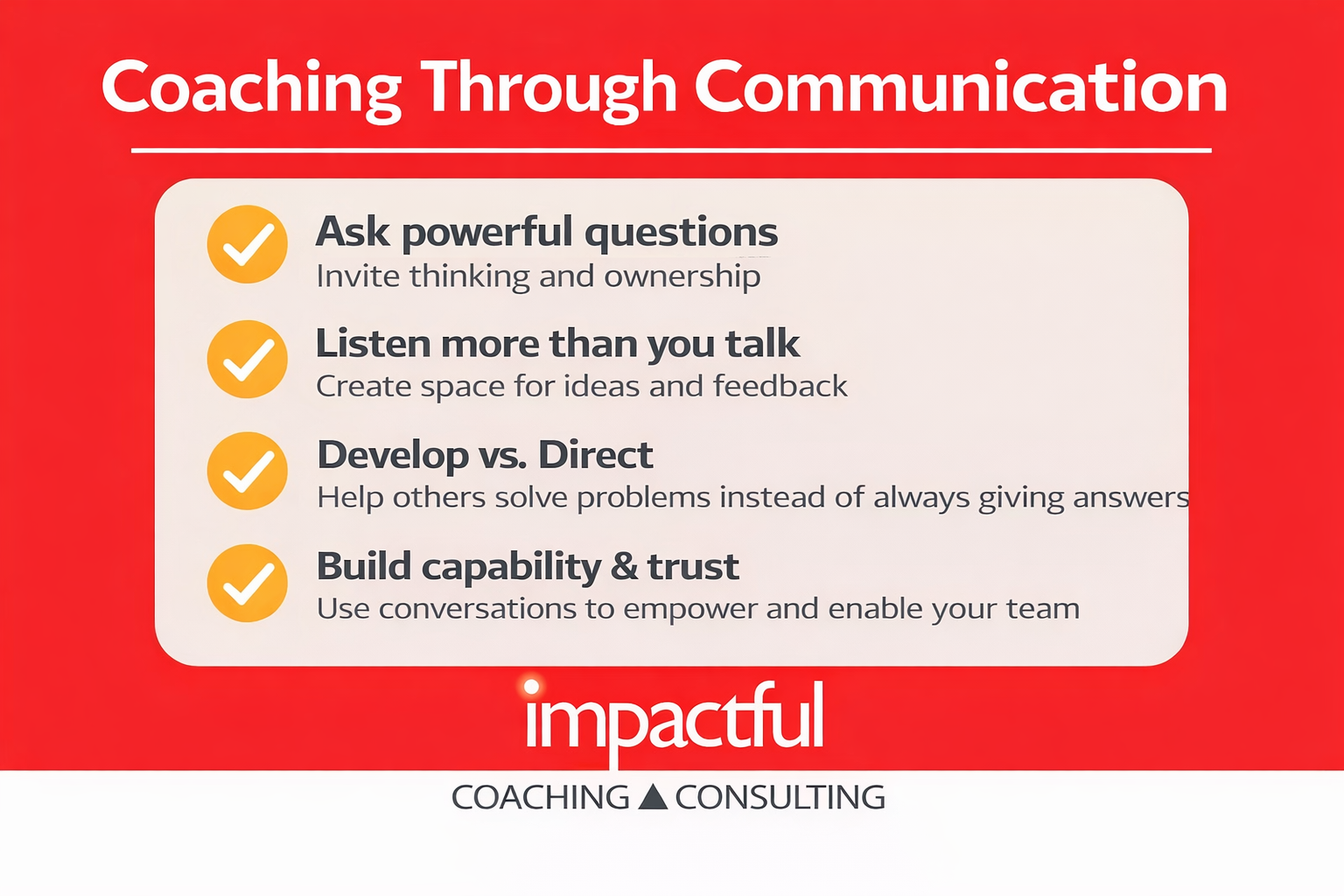
Why coaching builds stronger teams
When leaders coach through communication, a few powerful things happen:
1. Capability grows
People learn how to think, not just what to do.
2. Trust deepens
Questions signal respect. Listening signals value.
3. Accountability increases
When people help shape the solution, they own the outcome.
4. Leaders get their time back
Teams that think don’t need constant rescuing.
Coaching is not slower in the long run—it’s faster because it compounds.
The conversations that matter most
Leadership communication isn’t about saying more.
It’s about being intentional in key moments:
One-on-one check-ins
Feedback conversations
Decision-making discussions
Moments of tension or uncertainty
In those moments, leaders are always teaching—whether they realize it or not.
They’re teaching:
How safe it is to speak up
Whether mistakes are learning opportunities or liabilities
If growth is expected or optional
Culture isn’t built in grand speeches.
It’s built in everyday conversations.
A question worth asking yourself
Here’s a simple reflection many leaders find powerful:
“After people talk with me, do they feel clearer—and more capable?”
Not just clearer about the task.
Clearer about their ability to handle it.
That’s the mark of leadership communication that actually develops people.
Final thought
Great leadership communication isn’t louder, longer, or more polished.
It’s more curious.
More intentional.
More human.
And when leaders learn to coach through how they communicate, they don’t just get better results.
They build people who can lead alongside them.
That’s where real leadership impact lives.