The Skill Everyone Assumes You Already Have
Years ago, I was invited to present at a regional education conference. The organizers asked for a menu of possible workshop topics, so I sent over a broad list, assuming they’d pick something flashy.
They picked How to Craft Effective Learning Objectives.
I was surprised. Not because objectives don’t matter, since they’re foundational to great teaching. I just figured the topic was so basic that every teacher had covered it early in their career. I expected maybe 10 or 20 people across two sessions.
Both sessions were standing room only. The organizers had to close the doors ten minutes before start time.
The basics aren’t as basic as we think
That experience taught me something I’ve seen proven again and again, in classrooms and in boardrooms:
The skills we assume people have already mastered are often the ones they most want help with.
Part of the reason is that these skills rarely get revisited. Teachers learn about objectives once, early on, and then spend years under pressure to cover material. Over time, the objective becomes a box to check, often just a description of the activity, rather than a clear target the whole lesson is built around.
The two topics schools ask for most
Today, in my work with yeshivos and day schools, the two topics I’m asked to present on more than any others are:
1. Crafting effective learning objectives. What exactly do we want our talmidim to know or be able to do by the end of this lesson? A strong objective names the outcome, sets the right level of thinking, and gives the teacher a target to plan backward from.
2. Checking for understanding. How do we know students have actually mastered it before we move on? Asking “Does everyone get it?” doesn’t tell us much. Quick checks during the lesson show us who’s with us, who isn’t, and what to adjust right now.
Get those two right, and nearly everything else in the lesson gets easier. Activities have a purpose, pacing makes sense, and students know what success looks like.
Not a teacher? This is your problem, too.
If you lead a team, swap “lesson” for “assignment” and “student” for “employee,” and the same two questions apply.
Are you clear on the outcome? Many delegated tasks fail before they start because the manager described the activity (“look into the vendor options”) instead of the result (“bring me a recommendation with costs and a timeline by Thursday”). That’s the business version of a vague learning objective.
Are you checking for understanding? “Any questions?” at the end of a meeting usually gets silence, and silence isn’t agreement. Strong leaders ask people to play back what they heard, or check in early on progress, before small misunderstandings turn into missed deadlines.
In my coaching work with executives, these gaps come up constantly, and they’re rarely about effort or talent. They’re about clarity. The best teachers and the best managers share the same habit: they define success up front and confirm it’s landing along the way.
Teach with Clarity: a live two-session masterclass
For educators, I’m running Teach with Clarity, a live masterclass for teachers, instructional coaches, and school leaders. It’s built around exactly these two skills.
When: Two Sunday evenings, October 25 and November 1, 8:00–9:30 PM ET
Where: Live on Zoom, with replays included
What you’ll walk away with: Templates, real examples, and classroom-ready tools you can use the next day
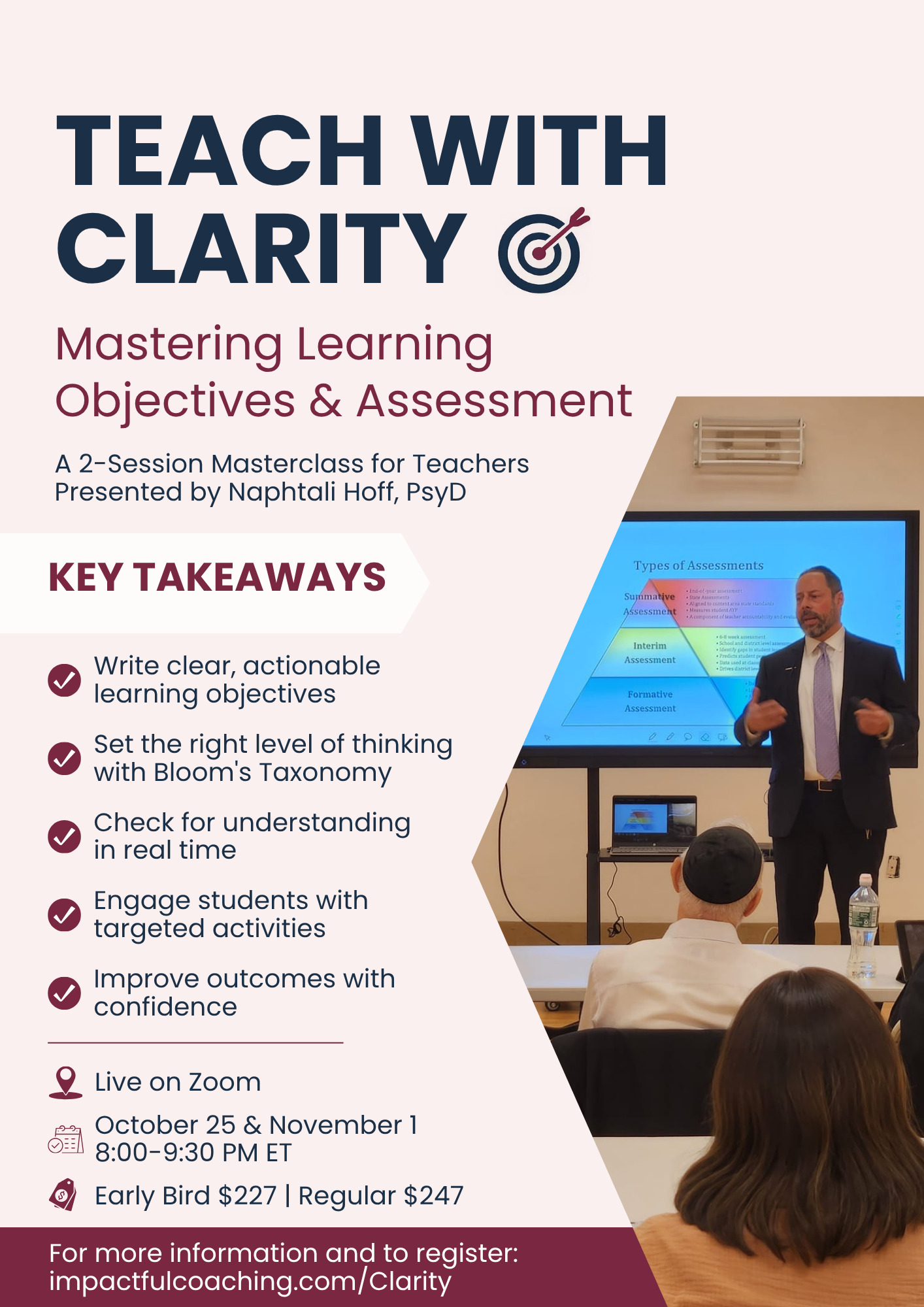
Early bird pricing ends Friday, October 16. If you’re bringing your team, group pricing is available.
👉 Register for Teach with Clarity here
Not in education but know a teacher or school leader who’d benefit? Please pass this along.